These games do not get gradually harder. They stay comfortable for a stretch, then jump, then settle again, and the jumps are placed deliberately at points where a design decision needs to be made about you.
The shape of the curve
Plot how hard the levels feel against how far you have progressed and you do not get a slope. You get plateaus with steps between them, and the steps are placed where the game needs to learn something about you or teach you something.
- The tutorial plateau. Everything is winnable first time. The purpose is to establish the habit of opening the game, not to test anything.
- The first wall. Usually the first level that cannot be won without using a special deliberately. It is where the game finds out whether you understood the mechanic it taught.
- The economy wall. Where the lives system becomes visible because losing twice in a row now costs a wait. This is where the free game starts asking to be a paid one.
- The plateau walls. Recurring afterwards at intervals, usually introducing one new obstacle each time and then relaxing while you learn it.
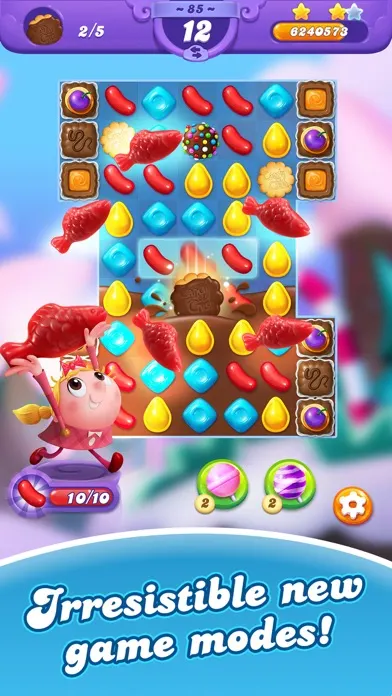


A level that stops you dead after a comfortable run is usually a designed wall rather than bad play. The useful response is to look for the new element it introduced, because there almost always is exactly one.
Telling a wall from a bad run
Three signals separate them, and all three are checkable.
- Something new is on the board. An obstacle, a goal type or a layout you have not seen. That is a wall, and the level is teaching it.
- The ratio changed. Compare goal against moves as you did on the previous level. A visible tightening is design, not luck.
- Everyone stops here. If the level number is one that other players discuss, it is a wall. Communities converge on the same numbers for a reason.
If none of the three applies, it was probably a bad run, and the honest response is to replay it rather than to look for an explanation.
Why walls are placed where they are
Not malice, and not entirely commerce either. A game with no walls is one where nothing is learned and nothing is remembered; the plateau after a wall is where a newly learned mechanic becomes comfortable, and that rhythm is genuinely good design.
The commercial part is real too, and it is worth naming honestly. A wall is the point where a free player is most likely to spend, because the frustration is highest and the offer arrives at exactly that moment. Both things are true at once, and understanding that makes the offer easier to decline without resenting the game.
Getting through one
The approaches that work on a wall are different from ordinary levels, because a wall is usually a knowledge problem rather than an execution problem.
- Identify the new element and find out what actually removes it. Guessing costs attempts; two minutes of reading does not.
- Fail once deliberately and watch rather than play. Where is the goal, what opens late, what spreads.
- Plan the opening around the new element rather than around the goal. On a wall the new thing is the level.
- Spend a booster here if you are going to spend one at all. Walls are where boosters change the structure of a level rather than merely adding progress.
When to stop climbing
Worth saying plainly. Some walls in these games are tuned so that a player without a substantial booster inventory will lose repeatedly, and no amount of skill closes that gap on a specific attempt. Recognising one is not defeatism; it is the difference between coming back tomorrow with free lives and spending money at the worst possible moment.
Nothing in these games expires. The level is identical tomorrow, the lives refill for nothing, and a wall that took three days to pass is a completely normal outcome that costs precisely zero.